
Getting Started With Airport Transfers: Train, Taxi or Rideshare?
Key points
- Trains, buses and shared shuttles charge per person, while taxis and private cars charge per vehicle, so the cheapest choice changes with group size.
- The train ticket covers only the station leg. Add the ride from the station to your hotel before comparing it with a door-to-door car.
- Flat airport taxi fares are regulated in some cities, like $40 from Miami to South Beach, but not everywhere; Seattle regulates only the meter.
- Rideshare prices move with demand, and the app’s estimate at the moment you book is the only figure worth planning around.
- Confirm the rideshare pickup zone before leaving baggage claim, because it is often not the same curb as the taxi rank.
The flight is booked and the hotel is set, but one decision still shapes the first hours of a city break: how to get from the arrival gate to your room. The fare quoted online is often not the fare you pay. Here is how the main options compare.
Why the Last Mile Matters on a City Break
The train ticket covers only the ride to the station. If that station sits a long way from your hotel, the onward leg belongs in the total too, and on some routes that single addition changes the answer.
Pricing works two ways, too. Trains, buses and shared shuttles charge each traveler, so two people pay double and four pay quadruple. Taxis charge for the vehicle, and the fare barely moves whether one person or four climb in. That creates a break-even group size on every route, the point where the car becomes cheaper per head.
The choice weighs heaviest on short trips, where arrival day eats into limited sightseeing time. Our guide to planning a 48-hour city break treats the transfer as part of the itinerary for good reason.
Find Your Options Before You Land
Check the airport’s official ground transportation page before departure. For each option, note the total cost for your party, including tolls, airport charges and any tip; the pickup and waiting times, since a late flight can arrive after the last useful train; the walking route, lifts and platform access; and vehicle capacity. Many cities also sell airport express tickets through their transit app.
Airport Trains: Cheap Per Person, Pricey for Four
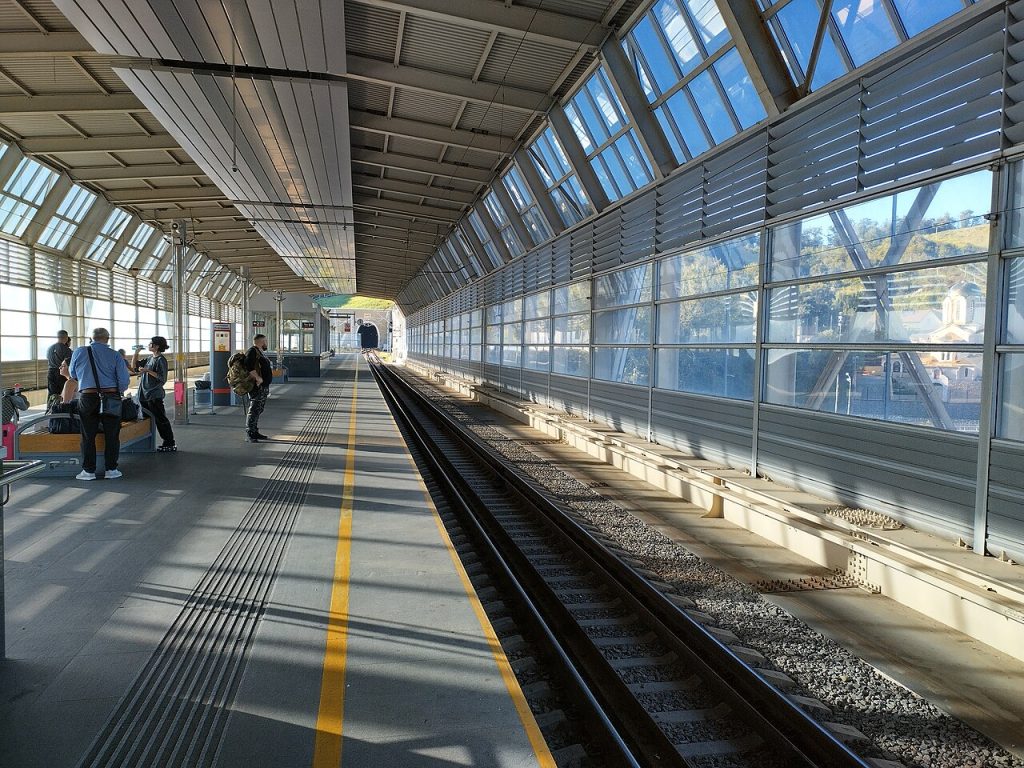
Rail links are usually the cheapest way into town, and often quick. Seattle’s Link Light Rail costs $3.00 per adult, takes about 40 minutes to downtown and avoids road traffic entirely; children under 6 ride free. Portland’s MAX Red Line costs $2.50 and reaches downtown in roughly 38 to 42 minutes, with trains about every 15 minutes.
From JFK, the AirTrain fare is $8.75 plus a separate $3.00 subway fare, or $11.75 for a normal adult trip. Philadelphia’s SEPTA Airport Line costs $6.75, reaches Center City in 25 to 30 minutes and runs every 30 minutes from about 5 AM to 12:30 AM.
The trade-offs are luggage and the final walk, so check how far your hotel sits from the nearest station. If fare vocabulary is new, our guide to city transit terms to know covers passes, transfers and fare caps. Accessibility varies too, so confirm the connecting station as well as the airport station.
Taxis: Official Ranks, Meters and Flat Fares
Licensed taxis wait at official ranks, and some cities regulate flat airport fares. Miami International charges a flat $40.00 to South Beach, $27.00 to PortMiami and $25.00 to Downtown and Brickell, with no surge multipliers and mandatory credit card acceptance. Philadelphia taxis run a flat $28.50 to Center City for the first passenger plus $1 for each additional one.
Do not assume a flat rate exists everywhere. In Seattle, a widely repeated $40 figure has no official basis; the local rule states that no flat rate is established between downtown and the airport, and only the meter is regulated, with a $20 minimum for trips leaving the airport. Downtown sits roughly 14 miles out, so a smooth run works out to about $39 on the meter, not counting waiting time. Every minute spent under 11 mph adds $0.50, and tipping 15 to 20 percent is customary.
Watch the headline fare at JFK. The regulated base to Manhattan is $70, but surcharges stack: a $0.50 transit surcharge, a $1 improvement surcharge, a $2 airport pickup fee, $5 for a weekday 4 to 8 PM pickup, and Manhattan congestion charges of $2.50 plus $0.75 depending on route. A qualifying weekday rush-hour trip to an address south of 60th Street starts at $81.75 before tolls and tip.
Rideshares and Shared Shuttles
Rideshare prices move with demand. When traffic is heavy, weather turns bad or a big event draws crowds, ride prices climb above the taxi meter; in quiet periods they often dip below. The quote the app shows when you actually book is the only figure worth planning around, so check it against the taxi option first. Typical ranges: $15 to $40 for a standard ride from Minneapolis airport, and $40 to $65 in Philadelphia.
One detail trips up new arrivals: rideshare pickups usually happen somewhere other than the taxi rank, so follow the app’s instructions for your terminal.
Travel tip
Confirm the pickup zone before leaving baggage claim. Airports often send rideshare drivers to a different curb, floor or lot than taxis; in Portland, for example, app pickups sit at a designated area on the lower roadway.
Shared shuttles fill the middle ground: per-person prices, typically 30 to 50 percent less than a private cab, useful where no rail link exists. Some larger or airport-adjacent hotels also run free shuttles, so check your hotel’s website.
Compare the Whole Trip Before You Fly
Build the door-to-door total for the same destination and passenger count, not the headline fare. Two train tickets at $18 each plus a $12 taxi from the station cost $48, while an all-in car quote of $65 costs $17 more, which can be a sensible trade if it avoids a difficult transfer.
| Option | Pricing model | Example fares | Fits best |
|---|---|---|---|
| Airport train | Per person | $2.50 Portland, $3.00 Seattle, $6.75 Philadelphia, $11.75 JFK | Solo travelers, light luggage |
| Flat-fare taxi | Per vehicle | $25 to $40 Miami, $28.50 Philadelphia, $38.70 Portland | Groups, late arrivals |
| Metered taxi | Vehicle plus time | About $39 in Seattle before tip | No flat-rate route |
| Rideshare | Per vehicle, dynamic | $15 to $40 Minneapolis, $40 to $65 Philadelphia | Off-peak arrivals |
| Shared shuttle | Per person | 30 to 50 percent under a cab | No rail link |
Then avoid the classic arrival-day mistakes:
- Comparing headline fares instead of door-to-door totals.
- Calling the car expensive for four, when per-person fares multiplied four times may cost more.
- Trusting a flat rate that no regulator has set.
- Missing the last train, such as Philadelphia’s Airport Line ending around 12:30 AM.
One small first step: before your next flight, open the airport’s official ground transportation page and write down the train fare, the taxi rule and your hotel’s nearest station.
Questions travelers ask
How do I know if my hotel is walkable from the airport train station?
Check both addresses on a map and add any onward taxi or bus fare and travel time to the train’s cost. That total is the number to compare against a door-to-door car.
Are taxis at the airport always more expensive than rideshares?
No. Rideshare fares move with demand and can climb above a metered taxi during rush hours, bad weather and big events, then drop below it in quiet periods. Compare the app quote against the taxi rule.
What is a flat airport taxi fare?
It is a regulated single price for the trip between an airport and a defined destination, such as a downtown district or cruise port. Some cities set one by ordinance; others regulate only the meter.
Should I book an airport transfer before I fly?
A pre-booked transfer gives a fixed per-vehicle price with a driver meeting you at arrivals, which suits groups and late flights. Check the cancellation terms and pickup instructions before paying.