
Do the Northern Lights Really Only Appear in Winter?
Key points
- The aurora occurs year round, though the University of Alaska Fairbanks Geophysical Institute notes it is least common near the solstices; you can only see it when the sky is dark.
- Alaska’s viewing season runs from late August into April, with March and September getting an equinox boost that roughly doubles the odds in interior Alaska.
- A high Kp index is a forecast of activity, not a guarantee: the aurora must be occurring, the sky dark and the sky clear.
- Clouds block the view even during a strong storm, so plan several nights rather than one.
- The usual display is a greenish white ribbon, not the saturated color of a headline photo.
Search for advice on the northern lights and a few claims show up again and again: they are a winter event, they need bitter cold, and a high Kp number means a show is coming. Each holds a piece of the truth and misleads in a way that can cost you a trip. What follows separates the parts that hold up from the parts that do not, using forecasts and park guidance rather than luck.
Myth: The Lights Only Come Out in Winter
The aurora runs all year. The National Park Service calls it a year-round phenomenon, and the University of Alaska Fairbanks Geophysical Institute records it in every month, though it notes the lights are least common near the solstices. What changes is how much dark sky you have to watch it against. In summer the northern sky never gets dark enough, so the curtains are there and invisible.
That gap explains a common disappointment. Most visitors to Alaska never see an aurora because they travel in summer, when skies are rarely dark enough. Nothing about the lights takes a season off. Your ability to see them does.
Fact: Aurora Season Follows Darkness, Not the Calendar
Alaska’s aurora season runs from late August into April. The edges are soft. Over Fairbanks, the sky is too light to see the aurora by mid-April, and the National Park Service tells Denali visitors to write off the aurora if their dates land in a six-week band on either side of the June solstice, around June 21. Locals in the interior put the autumn start near August 16, when the sky first gets dark enough to show stars.
Within that window, the usable hours shift with the light. In winter, Denali staff describe the sky as dark enough from about two hours after sunset to two hours before sunrise. In late August and September, twilight lingers, so a display that would fill a December evening may not arrive until late at night.
Myth: You Need Extreme Cold for a Good Show
Cold does not create aurora, and none of the viewing guidance here turns on temperature. March is one of the better months to stand outside in interior Alaska: the sky is often clear and it can be warm enough to enjoy staying out for more than a few minutes. The Geophysical Institute also notes a tendency for better displays in fall and spring.
If you are choosing between a January trip and a March one, weather comfort can be part of the decision without hurting your odds. What matters is darkness, a clear sky and being somewhere under or near the auroral oval.
Myth: A High Kp Index Means You Will See Them
The Kp index is a number from 0 to 9 that indicates how strong auroral activity is expected to be. It is a forecast, closer to a weather outlook than a promise, and the National Park Service lists conditions that all have to line up: the aurora has to be occurring, the sky has to be dark enough, and the sky has to be clear enough. A high number with cloud cover overhead gets you nothing.
Reading the forecast has a couple of traps. The first is time. Forecasts are issued in Coordinated Universal Time, and Alaska Standard Time runs nine hours behind it, while Alaska Daylight Time runs eight hours behind. A favorable window can land in your afternoon. The second trap is scale. One storm can be a big night in one place and nothing in another: during a G2 event, reports of aurora came from southern Canada and from Minnesota, Wisconsin, North Dakota and Michigan.
Travel tip
Convert forecast hours before you set an alarm. Alaska Standard Time is nine hours behind Coordinated Universal Time, and Alaska Daylight Time is eight hours behind.
Myth: Any Dark Spot Will Do
Darkness helps, but position does more. The aurora is most visible near the North and South Magnetic Poles, in a ring called the auroral oval. Alaska, Norway, Finland, Sweden, Greenland and Canada offer the most accessible viewing because of their latitude. The northern United States can get in on the act, and the southern states occasionally do when solar activity is extremely high.
Where you stand changes what you see. A display directly overhead at Fort Yukon appears about 20 degrees above the northern horizon to someone watching in Fairbanks. From farther south, the same lights sit low on the northern sky, which is why the standard advice is to get away from city lights and look north. Light pollution is its own cloud cover: it washes out faint arcs even on a clear night.
Myth: They Look Just Like the Photos
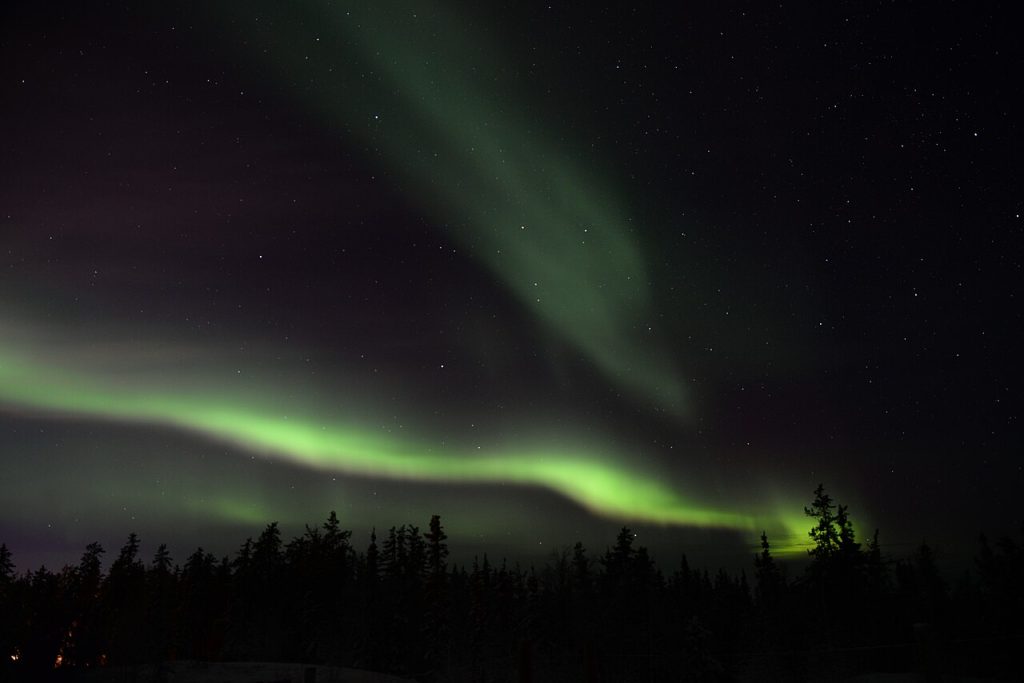
The everyday version is quieter than the headline version. Most often the aurora appears as greenish white ribbons stretching roughly east to west, usually with waves in them, and made of many parallel rays. Some displays are deep red and may be a shapeless glow, or a glow with rays.
The lights are visible with the unaided eye, and phone cameras have a night mode that helps you bring home a picture. Treat the descriptions above as the baseline and let a bright, overhead display be a bonus rather than the expectation you pack.
Fact: Cloud Cover and Trip Length Decide More Than Luck
Auroral light forms far above the weather, at altitudes beyond 60 miles, so any cloud layer sits between you and the show no matter how strong the storm is. The Park Service suggests checking a standard weather forecast along with a sky chart that rates cloud cover, and looking for the clearest squares in the cloud row.
Place matters for cloud as much as for latitude. Heading inland toward Fairbanks helps you escape persistent cloud cover, especially after autumn, and March tends to be clearer than the months that follow. NASA describes aurora viewing as a game of chance and asks sky watchers to be patient.
Patience has a schedule. The Geophysical Institute puts the best chance of bright arcs between about 11 p.m. and 1 a.m., NOAA gives 10 p.m. to 2 a.m. as the usual best window, and a professional aurora chaser quoted in National Geographic points to roughly 1 to 3 a.m., adding that the biggest reason people miss the show in Fairbanks is going to bed too early. Build in several nights so one overcast evening does not end the trip, and read our guide to how far ahead to plan a trip if you are working backward from a flight.
Fact: The Equinoxes Give You Better Odds
NOAA’s Space Weather Prediction Center names the spring and fall equinoxes as the best times of year to see auroras. The reason is usually called the Russell-McPherron effect, after the 1973 paper that described it: around the equinoxes, the alignment between Earth’s magnetic field and the Sun’s lets more high-energy electrons into the atmosphere. The University of Alaska Fairbanks Geophysical Institute puts the effect in numbers, with chances of seeing aurora in interior Alaska in March and September roughly twice as high as at the summer and winter solstices.
The effect is a tendency, not a switch, and it depends on the type of solar feature driving the storm. Solar activity itself rises and falls over cycles of about 11 years. The 2024 peak of the current cycle brought displays as far south as Alabama, and the next cycle is expected to begin sometime between January 2029 and December 2032. Plan around seasons and darkness first. The solar cycle is context, not a booking tool.
Choosing a Season and Destination That Fit Your Trip
Start with the trip you can actually take. A dedicated aurora trip points toward interior Alaska between late August and April, or toward northern Scandinavia, Greenland or Canada, with March standing out for clearer skies and an equinox boost.
| Window | What the sources show | What to plan around |
|---|---|---|
| Late August to September | Season opens in interior Alaska, and the September equinox raises activity | Twilight lingers, so good displays tend to arrive late |
| March | Often clear in interior Alaska, with equinox odds roughly double the solstices | Nights are shorter than midwinter, though still dark enough |
| Mid-April to July | Too much daylight in the far north | Do not build the trip around aurora |
If your travel window is fixed and short, treat the lights as one possible evening rather than the reason for the trip. Winter visits to northern-tier US cities can deliver a display when a strong storm arrives, but the odds are lower and the lights sit near the horizon. If you are still deciding where to go, our guide to picking a destination when you could go anywhere covers how to weigh a fixed travel window against a wish list, and planning your first national park trip is a useful companion if Denali is on your list.
Before you book, pull up an aurora forecast and a cloud-cover forecast for the same nights and let the weaker of the two decide.
Questions travelers ask
Can you see the northern lights in summer?
Rarely in the far north. The aurora is a year-round phenomenon, but summer daylight keeps the sky too bright, and the National Park Service advises against expecting a display within six weeks of the June solstice at Denali.
What is the best month for the northern lights?
March and September get mentioned most. Both sit near an equinox, when activity tends to rise, and March often brings clearer skies in interior Alaska.
Do you need a high Kp number to see the aurora?
Not on its own. Kp indicates expected activity on a 0 to 9 scale, but you also need darkness and a clear sky, and your distance from the auroral oval decides how high the lights appear.
How late do you have to stay up?
Later than most people plan for. Guidance in the sources points to roughly 10 p.m. to 2 a.m. as a common window, with some aurora chasers favoring 1 to 3 a.m.